
Medical vs Vision Insurance for Eye Care: Which Plan Pays

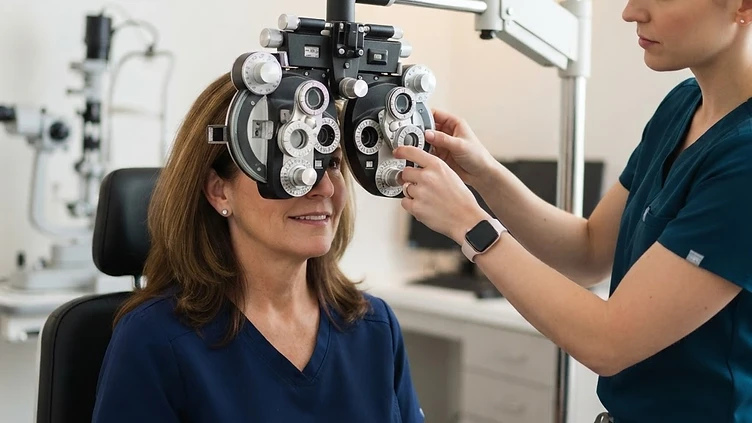
The reason for the visit decides which plan pays: routine vision exams bill the vision plan; disease, injury, and symptoms bill medical insurance. The refraction fee, two-bill days, check-in scripts, Medicare specifics, and whether vision insurance is worth it.
The eye doctor's office hands you two forms and a question that stumps almost everyone: is the visit medical or routine? The answer decides which insurance pays, which deductible counts, and which bill lands on the counter. The rule that governs it is simple to state and easy to get wrong: the reason for the visit decides — not the doctor, not the office, not the equipment. A routine vision exam and a medical eye exam happen in the same chair, with the same instruments, and often on the same day — and they are billed to entirely different plans.
This guide covers the dividing rule, concrete examples of each side, the refraction fee that neither plan loves, the conditions that are medical every time, cataract surgery and the glasses that follow it, the two-bill day, what to say at check-in, Medicare specifics, and the honest question of whether vision insurance is worth carrying at all.
The rule: the reason for the visit decides
“Medical” eye care is care for a disease, injury, or condition of the eye — diagnosis, management, treatment. “Routine” (refractive) eye care is the wellness-and-prescription side: the annual check of refractive error, the updated glasses or contact lens prescription, the screening of a healthy eye. The same patient can be a routine patient in March and a medical patient in April, and the classification follows the chief reason documented at the visit. This is why the question at check-in — “what brings you in today?” — is not small talk. It is the sorting algorithm for the entire claim.
Concrete examples of each side
Routine vision visits: annual eye exam for a healthy adult, prescription update for glasses, contact lens fitting, screening for someone with no symptoms or diagnosed conditions. These bill to a vision plan — benefits typically an annual exam plus an allowance toward frames and lenses or contacts.
Medical visits: a new floater with flashes, eye pain or redness, an injury, sudden vision loss, follow-up of a diagnosed condition. These bill to medical insurance — the health plan's office-visit copay, its deductible, its coinsurance — exactly like any other specialist visit.
The refraction fee — the charge neither plan covers cleanly
The refraction is the part of the exam that determines your prescription — the “better or worse, one or two” portion — and it carries its own procedure code and fee. Here is the quirk: medical insurance treats the refraction as non-covered, so when an exam bills as medical, the refraction fee is usually handed to the patient. Vision plans generally wrap it into the exam benefit. A patient who expects “my insurance covers eye exams” can receive a small, legitimate bill for exactly the refraction on a medical visit. Ask the office how they bill the refraction before the exam, not after.
Conditions that are medical every time
Some diagnoses move the whole visit to medical automatically, regardless of who scheduled it:
- Diabetes: diabetic eye disease management and screening bills medically — diabetic retinopathy exams are a covered medical benefit, including under Medicare Part B.
- Glaucoma: suspicion, diagnosis, and management — medical, always.
- Macular degeneration: diagnosis and monitoring — medical, always.
- Dry eye disease: as a treated diagnosis rather than a complaint — medical. (A mild annoyance mentioned in passing may not flip the visit; the documented treatment plan does.)
If a chronic condition exists, the wise structure is an annual medical exam for disease management and a separate vision-plan rhythm for the prescription side — the same doctor can serve both, with different claims.
Cataract surgery: billed medical, glasses afterward
Cataract surgery is the clearest example of the seam between systems: the surgery itself is a medical procedure — diagnosis, extraction, lens implant — billed to medical insurance with its deductibles and coinsurance, exactly as a hospital procedure would be. Afterward, the patient commonly needs new glasses to complete the correction, and that is the vision side: a vision plan's frame and lens allowance (or, for Medicare beneficiaries, the one pair of post-surgery glasses Part B pays for after an intraocular lens implant — see our Medicare dental and vision guide for where that benefit sits). One event, two systems, and knowing the seam is what keeps the second bill from being a surprise.
The two-bill day
When both happen in one visit — a routine exam that turns up something medical, or a medical visit that also updates a prescription — the encounter splits: the medical portion bills to medical insurance with its codes, the routine/refractive portion bills to the vision plan, and the patient receives two explanations of benefits and potentially two balances. This is normal and correct, not double-billing — but it should be named at check-out so the paperwork is expected. If you receive two bills for one visit, match each to its plan's EOB before paying either.
What to say at check-in
Three sentences make the whole system work: “I'm here for a routine exam and prescription” — if that is the truth — “I'm here because of [symptom/condition]” — if it is not — and “I carry both a medical plan and a vision plan; here are both cards.” Let the office do the sorting, but do not hide a known condition to make a visit “routine”: documenting a managed condition is what routes the claim correctly, and misclassification is corrected with documentation, not with omission.
Medicare specifics
Medicare beneficiaries feel this rule hardest, because Original Medicare has no routine vision benefit at all: no annual exams for glasses, no refractions, no frame allowances. What Part B does pay is medical, by name: the annual diabetic retinopathy exam, glaucoma testing for high-risk beneficiaries, and cataract surgery — with one pair of glasses after an intraocular lens implant. A senior's “vision coverage” therefore lives in one of two places: a Medicare Advantage plan's vision allowance, or a standalone vision plan beside Original Medicare. For the full allowance mechanics on the MA side, see the guide linked above.
Do you still need vision insurance?
The honest arithmetic: add up what you actually spend — exams, frames, lenses, contacts — in a typical year, and compare it to the vision plan's annual premium plus its copays and allowance limits. Glasses wearers who replace frames yearly or contact lens wearers with an annual fitting usually come out ahead; a single-pair-every-few-years glasses wearer often does not, and a discount arrangement can serve them better. Our vision insurance for exams, glasses, and contacts guide runs that arithmetic in detail, and the vision insurance vs discount plan comparison prices the alternative. The medical side is not optional — that is your health plan. The vision side is a spending decision.
How we can help
We review how your medical and vision plans coordinate — what your medical plan pays for eye disease, what your vision plan covers for exams and materials, and where the gaps leave you exposed — and price the standalone options for the gap you actually have. Call 855-277-7770 or 469-333-2220, or request a free consultation through our site — and start on our vision insurance page.
Educational notice: American Mutual Insurance Agency LLC is an independent licensed insurance agency providing general educational information only — not medical or legal advice. Plan designs vary; the routing of any specific claim is governed by its documented diagnosis and your plan documents.